Sunday, October 22, 2023

Goodbye, Vienna

We had a great time in Vienna, and both John and I agree that we’d love to return, as there is so much more we’d like to do here (art museums, opera, history, food & friends). We were very fortunate that Cecile invited us to her flat for brunch today. We so enjoyed meeting her family, and relaxing “at home,” as one of the challenges of long travel is always having to find food, and its easy to tire of restaurant meals. 

Noah, 11, plays soccer in the house while waiting for food.

I made him look at me.

Cecile in the sunlight.

Roland and John got along masterfully, and the discussions were fun, funny and lively. Arthur, 17, said a brief hello, but is in bed nursing a broken foot. Sadly I don’t have a photo of Lea, 20, but she’s brilliant and beautiful. I do hope we all meet again.

After brunch, we took a nice walk to the Hundertwasserhaus, built in 1985 as an eco-housing experiment.

The design is so loved that Austrian artist Hundertwasser has similarly designed buildings worldwide.

The apartments include green outdoor spaces on the balconies, roof and adjacent to the building in what has become known as Hundertwasser Village.

Even the support columns are colorful and fun as well as functional.

Each window is different.

So we must say Goodbye, Vienna. Thank you. It’s time to head east for the final leg of our adventure.
❤


Saturday, October 21, 2023

Vienna Day 3

Another beautiful sunny day in this beautiful cosmopolitan city. We started the morning with a walk from our hotel to the Belvedere Palace Gardens. Along the way, we passed this Russian Orthodox Church. Love the onion tops!


An interesting side note: The church is directly across the street from the Iranian Embassy. Armed guards were blocking traffic from the street, but didn’t seem to mind those of us on foot. Later in the day, John encountered more police at the ready during a pro-Palestinian rally. We kept our distance.

Lady lions decorate the entire perimeter of the palace garden.

Nearby buildings reflected in the palace pool.

The palace was the home of Eugene of Savoy until the mid 1700s. He was French, but apparently was “too short and too ugly” to serve Louis XIV. So instead he moved to Vienna and swore his loyalty to the Hapsburgs. 

The gardens were replete with spitting fountains and various strange-looking therianthropic sculptures.

From the palace, we walked to the memorial that honors the Soviet soldiers who liberated Austria during WWII. Many thousands died fighting facism.


Fountain and rainbow in Schwarzenbergplatz, adjacent to the war memorial.

After lunch, John walked to the Freud Museum, where he saw the famous psychoanalyst’s sofa…


And of course, Freud’s famous glasses.

I met up with Cecile for a bit more sightseeing. Above is the famous Ankuruhr clock, in which 12 historic figures “walk” across time every day. Here you see Joseph Hayden leaving and Marcus Aurelius entering the one o’clock hour.

The memorial to 65,000 Viennese Jews murdered in the Holocaust. The stern concrete block building is made to look like a library of identical books that can never be opened — so many life stories that never had a chance to be told. The memorial stands in Judenplatz, on the site of a large synagogue that was destroyed when the Jews were murdered and exiled from Vienna in 1421. 

The city continues to honor old and new. Many horse-drawn buggies ferry around tourists. This one is outside the famous Cafe Central.

Cecile also showed me some “hidden gems” of Vienna.


Finally, today’s Pastry of the Day was a chocolate brownie with nuts, topped with chocolate cream, and served with lavender ice cream on top of sautéed pears in cinnamon. Truly decadent. 
How am I ever going to eat American food again?


Friday, October 20, 2023

Vienna vibes

After nearly a month on the road (on the tracks?), we’ve landed in Vienna, a city so beautiful and with such a lively energy and so much to do and see, I’ve had little time to post, but here it is so far:

The last time I saw Cecile was nearly 20 years ago when Hannah and I visited Cecile and her family in Chartres. Cecile lived with us briefly when Hannah and Charlotte were young, so she holds a dear place in my heart.

In Chartres, circa 2005

Back to Vienna at St Stephensplatz in the evening light.

So much gorgeous architecture everywhere you look.

Pigeon roost

A blend of old and new reflects the city’s cool vibe

Statues everywhere you look make you feel like you’re in a city-wide art museum

Austrian dirndles and leiderhausen for girls and boys

Lots of bikes and pedestrian plazas. So much better than cars everywhere.

I accomplished my pilgrimage to the Venus of Willendorf! 
At 29,500 years old, she gets my vote for the OG Feminist.

Even the floors are beautiful, this one is in the Museum of Natural History.

Kunsthistorisches Museum

Gustav Klimt’s Death & Life, 1915, at the Leopold Museum

PS I did have an apple strudel pastry of the day. 
I ate it before I could get a photo. Guess I’ll have to eat another one…


Wednesday, October 18, 2023

Melk & The Final Solution

When planning our visit to Austria, I hadn’t planned to go to any WWII death camps, nor had I really given a lot of thought to the Jewish history of the many places in France, Germany, and Austria we intended to visit. But after learning about the history of the Jews in Dijon, our first stop, it seems that legacy is unavoidable.

As it turns out, Melk has been the biggest shock so far — a part of the Anschluss that, frankly, I didn’t know. What we’ve since learned is that, with a total of 14,390 men imprisoned here by April 1945, Melk is one of the largest labor/concentration camps in Austria. And now, we’ve seen what’s left of it.


The day is once again cold and windy as we walk up a hill beyond the old town of Melk in search of the camp. It’s not easy to find; no one here talks about it, and it doesn’t appear on any tourist brochures or websites. We ask the woman working the front desk, and she directs us to a military installation called Birago-Kaserne at 22 Prinzlstrasse. There, we are greeted by an armed soldier. We say we want to visit the camp. He checks with another guard. I trade my passport for a key. We walk farther up the hill and around a corner.


The key opens a small gated area with some grass and some small monuments surrounding a brick building. It’s small, too, like a house, but has a large chimney. This is the crematorium. We go inside and find the names — 4800 who died here — and dozens of tributes by families and nations who remember them. In Hebrew. In French. Norwegian. Italian. Russian and Polish.


It’s disturbingly quiet, except for a gardener outside mowing the grass. We are the only visitors.

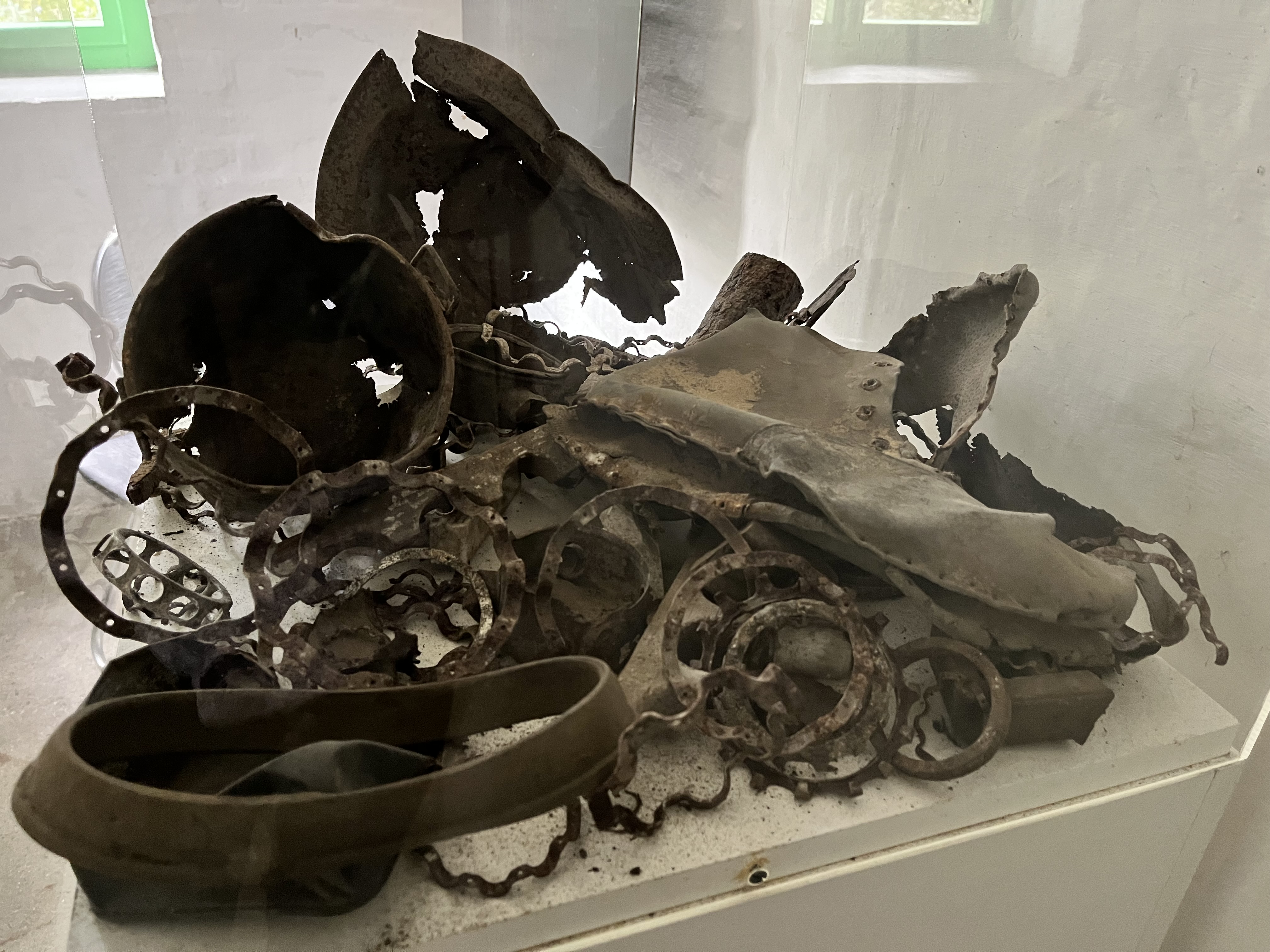
A modest exhibition tells the story: After Germany annexed Austria in March 1938, it used Austrian industry to support the Reich’s war machine. Companies such as Steyr-Daimler-Puch AG — the largest metal-working company in Austria, reincorporated as Reichswerke Herman Goering  — were made to manufacture tanks, guns, aircraft engines, and ball-bearings.

Labor was scarce, so the Reich built labor camps, including Mauthausen farther west on the Danube to serve as labor camps for the German/Austrian war machine. Then they built “sub-camps” — more places to hold deported political prisoners, Jews and other men of all nationalities and races. 

Melk was opened in April 1944 with an initial population of several thousand prisoners, mostly from France. More came in May, June, July and so on — 1575 from Poland, 1432 from Hungary, etc. — all men. About one-third were Jewish.

For a year, thousands of men were made to dig underground tunnels and build underground war production facilities. The code name for this action was Quarz. Food was scarce. They were cold and sick. More than 4800 died in Melk, the vast majority of whom were cremated.


When Soviet and Allied troops began to close in on Melk in 1945, Himmler ordered the remaining prisoners into the tunnels they were forced to build and that he wanted to blow up. The camp physician, Dr. Joseph Sora, and district authority Leopold Cornvall, stopped this plan. Instead, most of the surviving men, about 7400, were sent to Mauthausen. 36 died en route. The SS shot those left behind, who were too ill or weak to make the trip.

The names of the dead are all too familiar: Friedmann, Spiro, Simon, Weiss. Today, as Molotov cocktails were thrown into a synagogue and Jewish cultural center in Berlin in response to the war in Israel, we remember them.


Biking along the Danube

When we woke up today in Melk, the temperature was 38 degrees. When we left the hotel on e-bikes, it had gone up to about 40. And it was windy. We persevered anyway and got in about 20 miles before we abandoned ship (bike). But we got some good pix along the way. I couldn’t disappoint you.

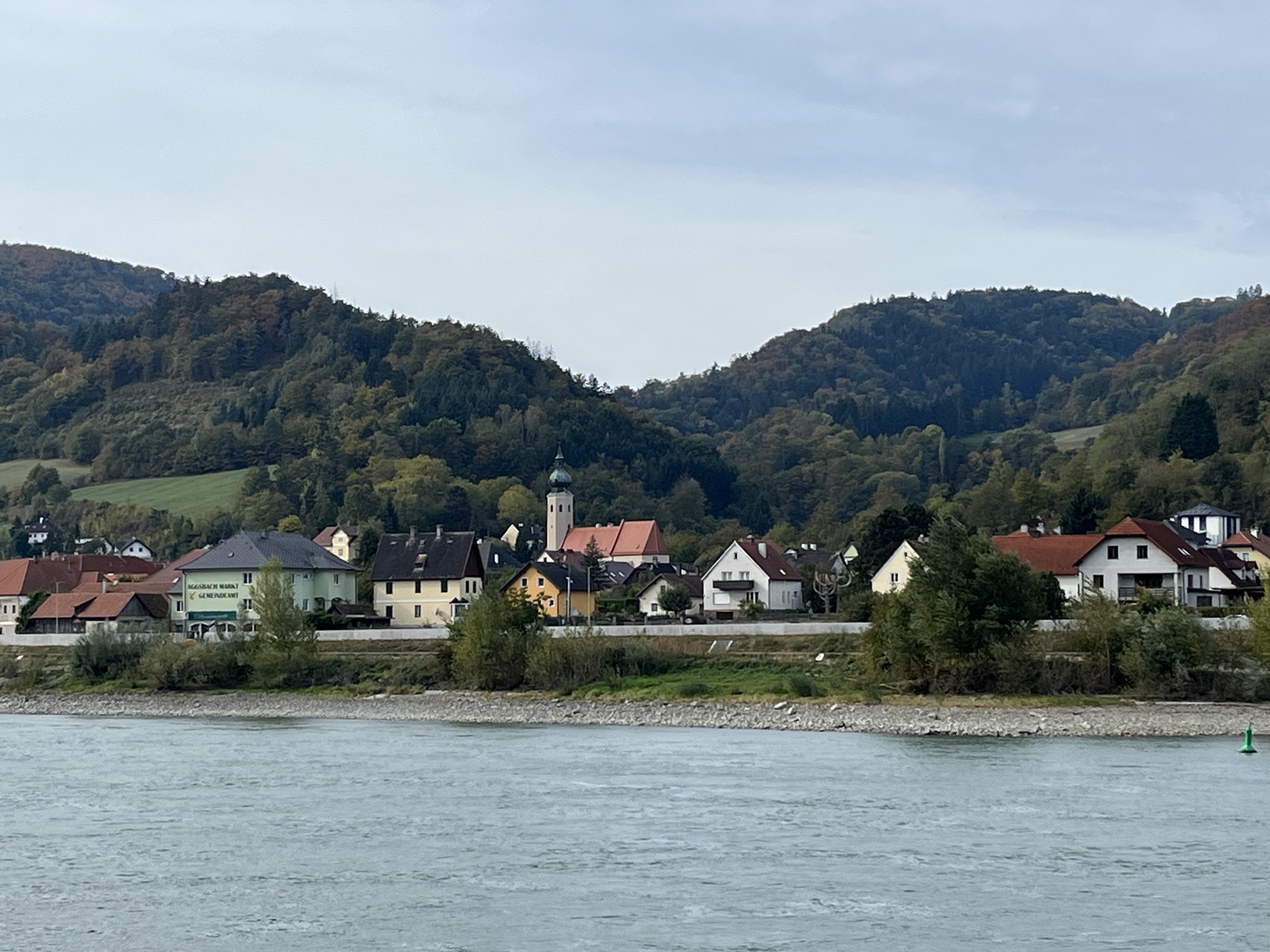
The bike path passes by a variety of castles and churches.

12th century Aggstein Castle

We tried to bike to the towns of Spitz and Durnstein, but there are no bridges, and the ferry across the Danube was closed for the season. Just river views, I’m afraid.

We did see lots of Danube river cruises for people who prefer to see the sights from a place of comfort.

Also on the path: Mr Hot Dog USA, at a beer stand, also closed for the season. Why?

Okay, we really were freezing.

Later, the day became all about food and getting warm.


First, for Hannah and Angela, pumpkin strudel (above) and pumpkin gnocchi (below). 


Warming soup with thin pancake strips.

Dumplings filled with pork on top of fried onions and sauerkraut fills the tummy.

And Pastry of the Day: Macaroon with chocolate filling stop a graham cookie dipped in chocolate. No idea if this is “Austrian” but it sure was good!


Idy Reno

Part of this summer's plan was doing some reno on our home in Idyllwild. Thanks to Buddy and  BBI Construction for their amazing work a...